


My Life In The Fantasy Culture Like so many Americans, when I was young I loved the writings of Mark Twain. I remember feeling a little pained in the early 70's when I discovered how dark and bitter he became near the end of his life. At that time I was living with two friends in an apartment in Seal Beach, California, all three of us attending Long Beach State University. Across the street from us lived a solitary old man who always seemed angry at everybody and actually used to shake his fist at us and curse us for no reason we could fathom. We found him a regular source of entertainment, but I knew of other men who seemed to sour as they aged as well, and they weren't always amusing. I wondered what had happened to them in their lives to so darken their views of the world. I wondered about Twain too. Now, in my mid-fifties, I think I'm beginning to understand. I was a Radio/TV Broadcasting major then. They call the major by different, more artistic sounding, names now. I believed that the mass media was the most potent tool for the shaping of culture. I didn't like what I heard on the radio or saw on television and worried at the direction our world seemed to be heading. I had embraced the philosophical idealism of the better part of the new American counterculture and wanted to play a role in changing the world. We youthful romantics knew we would change it. We would bring humanity to its senses, finally.
One day an associate vice president (or some similar title) from ABC News came to give a pep talk to the broadcasting majors. Wow, a real pro to talk to. That's when I really discovered how shallow the media pool was. The main gist of his talk centered on convincing students like myself to change majors. He went on and on about how broadcasting was an industry and not a public service. He explained in gruesome detail how our sole purpose as employees of that industry was to "sell soap". He hinted a few times at how that soap was not just a metaphor for corporate product, but also for corporate philosophy, aka propaganda. He alluded to the trivial jobs and professional dead ends that awaited those who bucked the system and the professors in attendance nodded their heads appropriately. Suddenly I saw my planned future begin to evaporate in a cloud of steamy rancid realism. They convinced me. After a period of depression, I left school, went on the road looking for the great alternative-lifestyle-commune in the sky, found it, joined it, discovered my unhappiness was not lifestyle related, left it, and unable to find decent work, joined the Navy. Join the Navy, See the World  I chose photography as my "rate" or military trade and after training found myself at the Naval Photographic Center in Washington DC. NAVPHOTOCEN was a large media complex right on the banks of the Potomac River. We called it NPC for short. We had color and black and white still photography departments, a television studio with a large sound stage, a complete motion picture production facility, and even a research and development department whose young officer in charge was interested in pyramid energy and was trying to find a military use for Kirlian photography (which reportedly photographs the "aura" of living things) so that he could have an excuse for studying it. The best he could do was to demonstrate its possible application as a letter bomb detector, so he never got funding for it. After a short stint as a photographic printer, and being a reel to reel tape recording buff, I talked myself into a spot in the sound recording branch and unexpectedly found myself a member of the White House MOPIC (motion picture) crew. It was our job to record everything the President of the United States said and did in public for the National Archives. My awareness of American realpolitik probably began there. We cheered as Nixon left and the Vietnam War ended, but I had to listen to every speech of our new President Ford and that was torturous. Luckily I didn't have to follow him around like the location crew did. I was sound lab staff and just had to listen to the same silly speech over and over as he went from town to town, changing the emphasis according to local politics. One of the location crew guys knew the standard speech so well he could actually lip-sync it as he transfered his master location tapes. We all found that very entertaining. I'll never forget the day the crew came back from the White House laughing about being outside Press Secretary Ron Nessen's office when suddenly the door opened and out came the Secretary and a group of laughing press people with a cloud of marijuana smoke billowing before them. My NPC coworkers were surprised at the blatancy of it. They knew what pot smelled like and what stoned people looked like, so I've no doubt the tale was true. I'll also never forget that shortly after President Nixon's departure, as I was on my way to the famous Yes! bookstore in Georgetown, I heard over the car radio the news report that Nixon had created a committee of close associates to study the feasibility of declaring martial law, suspending democracy, and indefinitely extending his presidency. I nearly lost control of my car when I heard that. That report is officially considered a myth today, but I heard it. Bill Still, creator of the important documentary The Money Masters, tells the story in a lecture viewable on Google Video that his father, one of the Pentagon's elite Air Force officers in the Nixon years, told him the story was not only true, but a White House official had told him that there was unlimited money behind the plan and any officer who wished to join it could name his price. I guess he couldn't find enough traitors. It was the mid-1970's and at NPC more than half of the enlisted men, and some of the officers and GS (government service) people, were pot smoking lefty counterculture sympathizers. A lot of us picked the Navy to join because of its slightly more liberal hair length regulations. It's silly I know, but we were kids, etc. I and two other Navy "freaks", as we called ourselves then, lived in a huge three bedroom apartment in Oxon Hill Maryland commuting to work via the infamous Beltway.
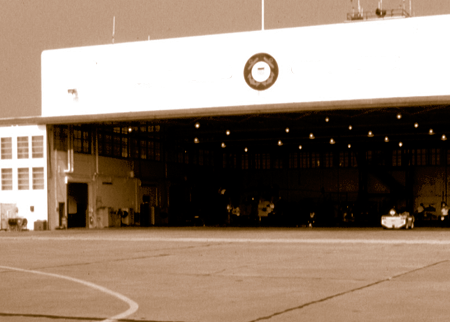
My duties while attached to Sound Recording at NPC included the occasional retrieval of one of the master tapes of presidential recordings held in the basement of the center. These included not only all public presidential speeches from JFK to Nixon, but also recordings made exclusively for the military and private oval office recordings of an unspecified nature. There was a line of large filing cabinets full of these seven inch reels which now, presumably, reside in the National Archives. As a student of JFK's public addresses for instance, I'm sure at least some of this material has never been released to the public. I'd love to hear what is on all those tapes. In 1976 Chief of Naval Operations Admiral James Lemuel Holloway III decided that our nation's fleets were undermanned and ordered some 35,000 unmarried petty officers to sea. That was the end of my and many of my friends' wonderful elite duty and I was ordered to report to RECONATKRON 9 (Reconnaissance Attack Squadron 9) or Heavy 9 as we called it, in Key West Florida. I was put to work maintaining huge cameras on large supersonic RA5C Vigilante reconnaissance aircraft that had originally been designed as nuclear bombers. I arrived at NAS Key West on Boca Chica Key just in time for the squadron's deployment aboard the world's first supercarrier, the USS Nimitz, for a two week work-up cruise leading up to the ship's first fully operational deployment to the Mediterranean. I walked in the day they were leaving and, not wanting to deal with me, they gave me the option of remaining ashore until they got back in two weeks. Picturing myself laying on the beach for two weeks, I agreed. I was told to report for work to the barracks manager and upon doing so, discovered he didn't know what to do with me, but he'd let me know. Next thing I knew I was assigned unspecified duties at a base hanger, so I reported to the assigned space the next day. My new duty station turned out to be an outside door near the back of a large empty hangar, but not accessible from inside the hangar. It was dead quiet and no one seemed to be around except one young seaman seated at a desk just inside the open door. He seemed thrilled to see his relief, babbling out my instructions in about two minutes before literally running off. I was to man the desk all day, every day, for the two weeks and dispense whatever items were requested from the storeroom, by whomever asked for them. I was not to ask for identification but have them sign for whatever they took in the log book.
 "How do I know who's authorized for this stuff?", I asked rather incredulous. "Anyone who asks is authorized. That's all I know. Besides, I've been here for two weeks and haven't seen a soul." he said. The last thing he told me before leaving was that the large tool box full of a wide assortment of beautiful brand new tools next to the desk was for me, personally. I said that was hardly regulation, but he enthusiastically assured me that it was s.o.p. and that everyone who got this duty received something similar. I ignored that and wondered if I should report him. It all seemed pretty odd, but you're taught not to ask questions, so I just sat down, a little nervous. I sat there for a couple days before curiosity finally forced me to look at what was in the storeroom. It was a small space with two rows of storage racks with something less than a hundred bins full of what looked mostly like electronic equipment. I couldn't identify a single thing. No matter. What did I know of avionics equipment? I sat there alone for two weeks, disturbed only once by a man in civilian clothes who curtly asked for something that I didn't recognize. He went in, found it, signed for it, and that was that. The two weeks passed and I went back to the squadron, without the tools. It was 20 years later, while listening to Col. Fletcher Prouty's recorded memoirs where he discusses the intelligence communitie's regular and little known use of military personnel, that I began to wonder if I had been TAD (temporarily assigned duty) to the CIA. Today there are more stories going around about the CIA's activities in southern Florida over the years than you can count. I probably should have taken the tools. Then came my first and only sea duty. Secret Wars... If you research the history of the USS Nimitz you'll find that its first cruise, departing 7 July 1976 and returning 7 February 1977, was officially "uneventful". You're probably guessing I'm going to dispute that and you're right. One way I think the military gets away with so much and endures so few whistleblowers is by creating a sort of chronically fatigued zombie enlisted population. Too much work and too little sleep is a useful methodology for psychological control. It's a fundamental part of boot camp training; to shape the new cogs for the military machine. It works well at sea too. We worked 12 hour shifts, 7 days a week, for months at a time. I was moved from day shift to night shift and back again every two weeks for part of that cruise. Imagine adjusting to that, and I worked on the flight deck which created considerable fatiguing stress simply due to the continuous danger. I remember once waking up about twenty feet from landing aircraft, sitting in one of the little tractors, uncertain of just how long I'd been sleeping. Luckily for me, no one noticed. Young men become more malleable when chronically sleep deprived and less likely to question their orders, at least I did.
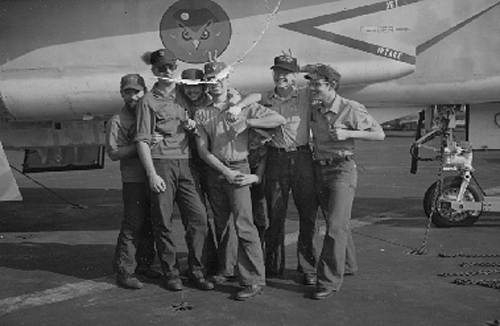 Me (2nd from left) and some of the the boys on the USS Nimitz flight deck. We all looked at each other wide-eyed and wondering and beat hell to our battle stations. It was in October I think. I remember collapsing exhausted in my rack each day for weeks afterward telling myself that I needed to write down that date before I forgot it, but I never did. I wanted to remember the exact date because I wanted to someday find out what really happened that day, because by all appearances we went to war for a day in October 1976.
 There were many drills to keep us in practice, but planes were always loaded with the little inexpensive blue practice bombs. This time huge green four or five hundred pound explosive monsters were being hurriedly strong-backed up to the plane's wings by four men at a time instead of using the bomb carriers. I knew this was forbidden even in wartime. Something was really up. We sent every plane that would fly that day and I vaguely remember some of them rearming and going again. Two planes came back with "unexpended maintenance", or bombs that were hung up. I watched as one landed, one bomb dangling from its rear mount, its nose down perilously low. It really looked like it would hit and explode on landing, but it didn't. I wanted to know who we were bombing. We were in the Mediterranean, but we peons were rarely allowed to know where we were. I remember asking many men if they knew anything as the day wore on. No one did, but I was surprised at how little anyone seemed to care, that is until I started asking the honchos. I used correct procedure and started with my immediate supervisor who knew nothing and didn't care, nor did the petty officer above him. When I got to my shop chief I still learned nothing but he smiled and suggested I not ask any further. The warning I got from his enlisted superior was stronger, but I wanted to know. When I finally got to the Master Chief I was subjected to a loud angry stream of profanities and a serious threat of punishment which stopped me in my tracks. I never got to an officer. I still don't know what it was all about, but we bombed the hell out of somebody that day in some sort of massive black operation. If the U.S. can do that and keep it quiet, God knows what else has been done over the years without getting into the history books. The cruise was clearly not "uneventful". I remember the ship being nose to nose with very impressive looking Russian cruisers, so close I was sure we would collide, but we didn't. We lost two planes on that cruise, one phantom barely missing the Island (the large flight deck control tower) as it turned away from landing in flames to dump in the sea, the crew quickly rescued. The other incident was truly mysterious. One day, during normal flight operations, the last plane to land just disappeared in a cloud bank well within sight of the ship as well as its radar. The small single pilot A-3 Corsair was seen going into a cloud on approach and then nothing. At first I didn't believe it, but the ship stayed there for days and we were all ordered to keep a sharp eye out for debris or anything. Nothing was ever found and I've always wondered how the incident was officially recorded and what they told his family. I could write a book about that cruise. I remember stories of fatal accidents and murders aboard ship. One fellow was found hanged in a passageway the day we returned to port. Throughout the cruise there were "wanted" style posters posted here and there around the ship asking for information on the whereabouts of missing men. It was a little floating city with nearly 5000 residents, all male, so I suppose it's not surprising, but is every cruise like that? I wouldn't be surprised, nor would I be surprised at the lengths the Pentagon probably goes to in covering it up. Without the necessary illusions, great military machines would be harder to justify, let alone great wars. I wonder sometimes at the adolescent naivete of the average American. I know why the naivete exists. I once majored in the naivete creating profession, but I'm almost in a perpetual state of despair over the stunning mental dimness of most of the people I have personally known in my life. It's easier and safer to stay small I suppose; just go to work, watch the game, and mouth the common banalities. Just look at what happens to whistleblowers in this culture. They are some of the greatest patriots we have and they're treated like traitors. Someone once told me about how fish markets used to have big barrels of live crabs sitting in them with no lid needed to keep the crabs from escaping. If a crab started to climb out the other crabs would grab it and pull it back down. No lid needed on the great American barrel either. The title of this piece refers to my personal pet name for my own culture. Everyone seems to have this fantastic view of our nation. I mean fantastic in the literal sense of fantasy-based. The cultural reality view is created and maintained by the mass media and the public education system. The culture at large then enforces it through peer pressure. I remember my own early schooling with the disdain so commonly felt and best expressed by the phrase: "Thank God it's finally over". I always view with suspicion those who say they loved it. I think it's valuable up to puberty. Reading, writing, and arithmetic are obviously invaluable. Everything after that is geared toward creating an incurious class of "productive citizens" with dishonest, propagandized history and classic literature well beyond the intellectual capabilities of the average adolescent. I still get an uncomfortable feeling when I pass the classics row in any bookstore. Why do you suppose that is? I feel like someone who when an infant was force fed beefsteak before I could digest it. I don't remember the infantile experience. I just avoid beefsteak. Those who break free of the enforced limitations on intellect are uncommon and often looked upon with jealousy and even contempt. The media has often pointed out this problem within America's black population but never mentions its ubiquity within the whole. I distinctly remember reading two articles in TV Guide Magazine in the early to mid 60s discussing the great debate in America over the controversial policy of the TV news networks to keep everything at the intellectual level of the average 12 year old. I remember it because it angered me. I was little more than 12 at the time, so I took notice. The networks argued that it was unfair to the nation's young people to discuss issues or explain events in a manner that was beyond their ability to understand. I never heard about any outcome of the debate, but you just have to turn on your TV to know who won.
COMMENTS: This is one of the best I have read. It is reminiscent of my own journey into reality. The author did a splendid job all around. Rob W. I am a woman who became aware of this reality as a child...I was always in fear of being recognized, and labeled as "one who knows"... Once while in my late 20's I was working on a County road crew... A big black limousine pulled up close to me and two men got out and led me to the car where an empty seat was waiting. They knew my name and more about me than I liked... All the men were dressed in black suits... one man on each side of me two facing me and two in the front seat... I was apprehensive and a bit freaked out, the worst thing I had ever done in my life was smoked some pot, and that was by myself... I ask them several times if I was under arrest and they were very evasive with the answerer, told me it depends... and I would have to sit there until I was told otherwise... The thing of it was they never said anything that I could put to what was happening, they ask me some ridiculous questions for about a half an hour, then told me I could should leave and go back to work... Very unsettling, and my co workers never believed I didn't know what it was about. That is the simple truth and I have never had another encounter with them... I have experienced a number of strange happenings in my life, but could never draw a line (dot to dot) and relate any of them together... I certainly have never been bored or had to look for adventure... It always seemed to find me... information comes to me without even asking the question... sometimes I don't even have a reason to know the incoming... I admire the story and the Author of "Fantasy Culture"... It is strange to know what's at the center of the onion and live your life as normal with a Mona Lisa smile. Lynda I too have experienced reality as a young person living in a fantasy world. My parents sent me to catholic school when I was five years old and I was being taught by nuns. In my day in the aerly 70's nuns taught the classes in catholic schools and the Superior nun was the principle. Anyway they continued to teach us through the fear of god. If we did not do things there way or live a certain way or learn a specific way we would all be punished by going to hell and living an eternal life of pain under satan. Well you can imagine what children think and what goes through their minds when they are reminded all thie time about the consequences of not doing what religion wanted you to do. I can remember several occasions during class I was supposed to learn childrens ryhmes and I had to learn five of them in one day. Like little miss muffett and Jack and Jill etc. I could not remember all the words to one of the rhymes and was told to repeat it after the nun instructed me. I was pretty tired and did not want to learn anymore so I told the nun no I did not want to. Well that was my first introduction to how the lord almighty handles people who say no. I was taken to the Superior nun and was told to stick out my hands. She pulled out a leather strap and told me that if I did not repeat the rhyme I would be strapped. Of course I cannot repeat it and I am scared shitless and almost crying. She then comes down with the strap and I pulled my hand out of the way thinking you have to be pretty stupid to leave your hands out and anticipate getting hit. So the other nun who is holding my hand gets the strap instead of me. I could see her whince in pain and grasp her hand. At the time I thought ok maybe they will stop and let me go. No this actually made it worse and she really held my hand tight and I got the strap five times on each hand. When I went home I showed my mother what they did and she was so upset she was going to the school to give them a piece of her mind but my father stopped her from doing this. I never knew why but thought later in life maybe it was because he was one of those victims to the church as well and wanted me to learn a lesson. Anyway I always found it hard to understand as we were also being taught that god forgives us for our sins and protects us and we would go to heaven if we behaved a certain way and did not commit any crimes and followed the commandments. This has always been a conflict with me when I was a child and could not understand how a God who loves everyone and forgives their sins would allow nuns to punish and threaten children with eventual damnation in hell if we were not listening and did not follow their ways. I guess I became kind of rebellious as I got older because when I was eight my parents decided to send me and my sister to Sunday School. I was quite apprehensive to say the least wondering if nuns would punish me and threaten me what would a priest do. Anyway I managed to make it through a few Sundays at church and learn about some of the wonderful stories about the bible. I then had an epiphemy come over me one Sunday and it was like I was hit by some kind of weird feeling or awakening. It was when the priest was talking to us and telling us the story of Jesus and Mary. He stated mary was pregnant with Jesus but it was not from Joseph it was a virgin child born without having intrcourse as God had given Mary the baby Jesus and he was the mesiah. It was then I had this feeling an overcoming urge to tell the priest that this was a lie. As it old him this he gave me a stern look and stared at me in awe for several seconds. In this time I thought ok here it comes I am going to be punished and something bad is going to happen to me. Anyway he did not do anything he just told me that I must accept the lord and know that it is true and I cannot question God and how he made Jesus. I told him my mother instructed me and my sister that babies come from having sex. As we lived on a farm and I know what animals do when they have sex. They bacame pregnant and another animal comes out. Especially when you are eight years old and see a horse on top of another humping away. Anyway I was at a point in my life where this priest is trying to tell me how people can have babies without sex and just be virgins. I could not grasp or understand this so I questioned him. He did not like it. He called my parents to come get me and my sister and told them if I continued to think and be taught differently I would not be allowed to participate in Sunday school anymore. Well my mother told the priest right there in from tof my father that she respected my ideas and would allow me to express myself freely and speak up. We then left and I never went back. Of course through the years I read the bible on my own several times and have had many conflicting ideas about the wanderings of christ and all the wonderful stories it has. I questioned Adam and Eve wandering how Eve could be made from one of Adams ribs. I questioned how Noah managed to build a giant Ark and have all the animals in the world two by two be saved from a giant flood, I questioned the Ark of the covenenat and how the ten commandments were kept inside and it had this power that could wipe out armies, I questioned the seas being parted and all the other stories. Then it dawned on me these things what if god was an alien being with powers of science way more advanced than us. What if DNA was taken from Adams rib to make eve a scientific approach to creating humans. What if Adam was the early primitive man and DNA was taken from his rib by Aliens to make Eve a hybrid and she was impregnated by Adam to make other hybrids? Would this make sense as we are made in Gods image? What if Mary was given sperm from an Alien being to impregnate her in order to have Jesue without having sex and Jesus was an actual alien hybrid. This would expalin why he could heal people and make miracles happen. He floated above water etc. etc. and was killed for his actions and power as he started a new culture of free thinkers and could start a rebellion against the Jewish Lords and Romans. He was sacrificed for being different. The same as the Ark of the Covenant it was made by Aliens to have special powers that could emit radioactivity or sometype of powerful weapon to eliminate enemies. Noahs Ark was built with assistance from aliens and animals were given along with DNA from other animals a kind of specimen bank to replenish the world once the flood was over. The funny thing is we are doing this today. Everything in the bible is actually happening today. The power to make people without intercourse, the power to float on water fly in the skies part waves and make powerful weapons to destroy armies and countries. This is all happenning today. Where is God and Jesus in all this? We ar emissing the most important factor like in the bible where are the angels who come down from the heavens (sky) and instruct us like in the bible. These angels are aliens that have been here for centuries before man was ever here. They created us taught us and made us belivee in ourselves and our sciences. They gave all of this to us. How we think how we live and make giant leaps and bounds to create and understand it is all from them. The are among us now and live with us and have been. We just don't know them or see them. We only have small glimpses of their technology or have very few human conatct and our governments like the catholic church have a great great secret they have kept hidden from us all for many years. They need to be in control of us and cannot allow us to be free thinkers. This will create confusion for them and they cannot stope us from making our own decisions and running th plane they way we want. So they keep all this technology and information and power from us to control us and abuse our lives in a way to have power. It's happening now and it willnto stop until someone who is in power and who has knowledge comes forward and tells the world the truth. Ron B.
|


 My first two years at the university were spent completing all the general education requirements. In my fifth semester, I dove headlong into the exciting pool of my major and struck bottom. I'd had no notion of how shallow it was. To shorten the tale, I soon learned that few of my fellow future broadcasters shared my idealism.
 Our living room was the size of a small night club, so it was the perfect party pad. Our parties gradually became well known due to our openness to pot smoking and occasionally non NPC personnel who were friends of friends would attend. Some of these were intelligence community GS people, readily identifiable due to their non-military haircuts. One of them, with a security clearance several levels above Top Secret, grudgingly admitted to a handful of us, still hanging around in the wee hours after one of our parties, that the Roswell stories were true. He was goaded into the admission by unrelenting prodding by one of my less sensitive friends who had been bugging him, for several parties in a row, to tell us what he worked on in his supposedly secret underground command. Most of us never asked these guys anything, knowing full well the possible consequences of disclosing classified material. It was, to say the least, impolite. He stopped coming to our parties after that and we never spoke of it, embarrassed at the behavior of our prodding friend. It's just another hearsay story, of course, but the guy was convincing.